So your area has been prepared and most of the hard work has been done, and you are ready to start laying your turf? Many will say it’s seen as putting on the final touches and it the fun part!
Regardless of what grass you have selected; the laying process is the same.
Its important to follow the steps set out below, ensuring every step is carefully considered so not only the best outcome can be achieved but also to reduce the amount of work involved.
Turf delivery – it’s important to ensure that when the turf is delivered it is delivered as close as possible to your new lawn area and/or the point of laying. This reduces the amount of carrying and wheel barrowing of turf therefore allowing the laying process to be faster.
Lay straight away – it’s important to get the turf laid at the earliest possible moment after it is delivered particularly during hot weather. The longer the turf sits on the pallet, the more it will potentially ‘cook’ and therefore yellow and in extreme cases it can die it its left too long.
Planning to lay – its recommended to start laying your turf at the closest point to the turf stash and work your way across the newly prepared soil area. This is done to ensure you are not walking over freshly prepared soil disturbing the newly prepared soil levels. Instead, you are working across the turf as you lay it, this means your soil levels will not be disturbed. As laying progresses, turf can be transported using a wheelbarrow. If for any reason the soil levels do get disturbed by footprints or the wheelbarrow, it is important to rake & relevel areas as needed to keep the soil surface flat & smooth.
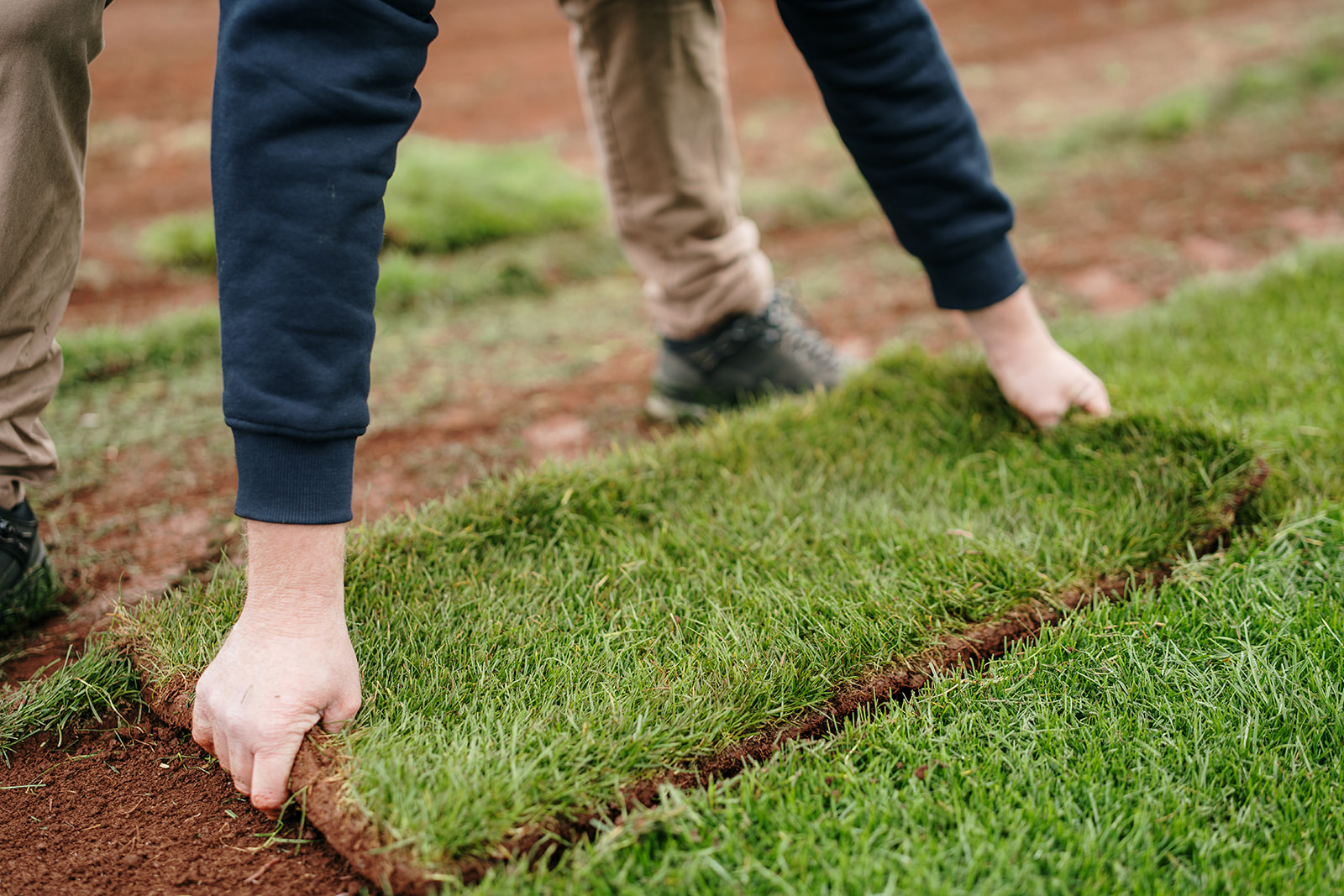
Actual laying process – It is best to start laying turf up against a straight edge such as a concrete path or a fence. This ensures the laying gets off on the right foot in a nice straight formation. Laying should be done by butting rolls up tightly against each other and laid in a brickwork pattern (in the same way that bricks are laid on a house) as this helps the turf to knit in better during the grow in phase and it also helps to prevent wash out/erosion in the event of heavy rain – when laid in a brickwork pattern water will not have as many straight lines to follow.
It is important to lay full slabs of turf up against hard surfaces as they are less likely to dry when compared to smaller, odd shape pieces. More generally, try to avoid using smaller pieces where possible as they will dry out easily and require more watering during the early grow in stages. If small pieces do dry out and require replacing this puts these isolated areas back to square one requiring them to be relaid & therefore restarting the watering/establishment. So try to avoid using small pieces where possible.
Any turf laid overlapping or over run onto paths or hard surfaces can be cut with a sharp knife or spade to the required shape and size. Although not 100% necessary, it is recommended to roll the newly laid turf area to increase the soil – turf contact and increases the success rate of establishment. Rolling also smooths the whole surface; slows the rate the turf will dry out and can reduce the amount of water needed during the first few days.
Once Laid
- Initial Watering: It is important to commence watering at the earlies possible moment. Depending on the temperature and the size of the lawn, if temperatures and really high, it may be a requirement to hand water the newly laid grass as laying progresses. The day the lawn is laid it should be watered at least 3 times that day. This is required to wet the depth of the turf and its associated soil beneath all the way through.
- Daily Watering: Watering of your new lawn will be required somewhere between 2 to 4 times per day —for the first 7–10 days. It is important to remember once the new turf is laid the only support system it has is the daily watering until such time it starts to grow it’s own roots down into the soil so it can support itself. During watering aim for 5mm to 10mm of water each time to keep the turf and its soil base consistently moist throughout its depth. During this phase its not possible to over water the turf. If you think it needs watering, then it’s likely that it does. The healthier it is, the quicker it will send roots into the soil beneath.
- Landfall Turf Variety Water Requirements: While there are some variables with how much water each of our turf varieties need, it is not a huge factor, and each species should be treated the same way during this early watering phase.
- Post-Establishment: It usually takes between 7-10 days for the turf’s root system to anchor down into the soil. This can be easily checked daily by lightly pulling at the turf to check its anchorage. Once the turf root system has fully anchored into the soil watering can gradually be reduced. Once this point has been reached, as a general rule of thumb watering should be first reduced to once per day for approximately 5 days, then to every second day for a few days after this, then eventually to 1-2 times per week (depending on time of year) Once your new lawn’s root system is well established mowing can start. This can be checked by gently pulling at the turf to test the anchorage. Once the anchorage is firm and there is no movement in the turf, mowing can commence. Remember to follow the 1/3 rule and that is to never remove any more than 1/3 of the height of grass in any one mowing.